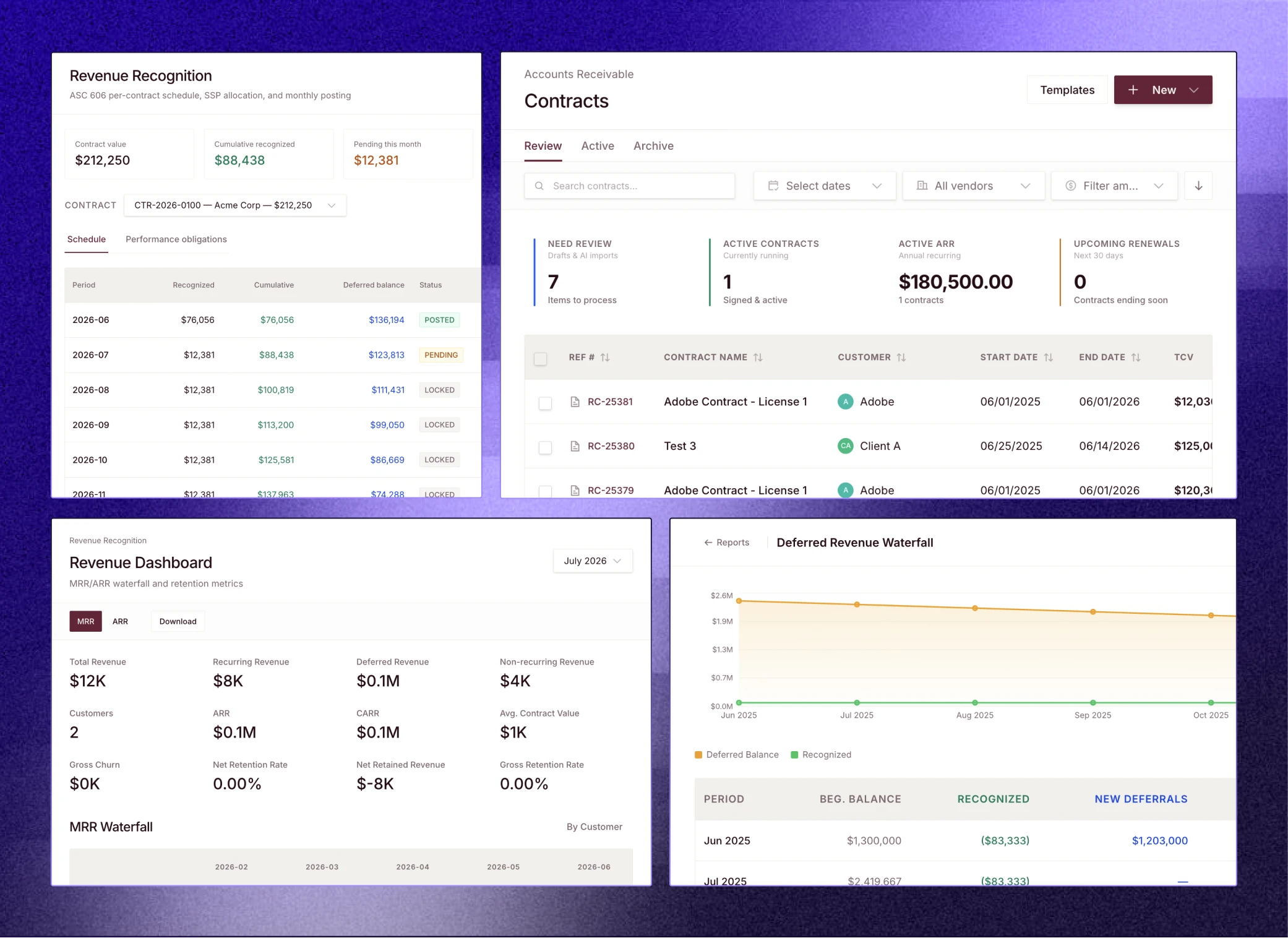
Month-end revenue should be a review, not a rebuild. Rivane reads each contract, generates its recognition schedule under rules you define, and keeps every recognized amount traceable back to its source.
- and IFRS 15, compliant by default
- ASC 606
- manual schedules
- 0
- models: flat-rate, usage, tiered, milestone, hybrid
- 5
From signed contract to schedule
Contracts sync from your CRM and billing system. Rivane reads the terms and generates the recognition pattern, with no rekeying and no template spreadsheets. Standalone selling price logic is set once and applied at scale, and the transaction price is allocated across performance obligations by your rules.
- 1Identify the contract
Synced from CRM and billing, coded and ready to schedule.
- 2Find the obligations
Multi-element arrangements split into performance obligations.
- 3Price and allocate
Transaction price allocated on the SSP rules you set.
- 4Recognize and post
The schedule posts each period and rolls forward on its own.
Judgement cannot be outsourced. A human must remain in the loop, applying critical review and sense checking before any machine generated outputs are relied upon.
 Jemma EwinCEO & Co‑Founder · Global CFOJemma Ewin, CEO & Co‑Founder · Global CFO
That is why the rules are yours. Rivane does the arithmetic and the posting. The judgements on obligations, SSP and modifications stay with your team, and every one is on the record.
The waterfall maintains itself
- Live deferred revenue waterfall. Deferred and accrued balances update as invoices post and contracts change.
- Auto roll-forward. Each period rolls forward without a rebuild.
- Tie-out to the GL. One click from the waterfall to the ledger.
Mid-term changes without the rework
Upgrades, downgrades and cancellations reallocate remaining revenue, prospectively or retrospectively, and Rivane posts the catch-up entry for you, with a change history on every contract.
- A manual schedule per deal
- Amendments rebuilt by hand
- Waterfall rebuilt each close
- Audit trail reconstructed after the fact
- Generated from the contract
- Auto-reallocated
- Always live
- Built in
Further reading
Questions
Does Rivane support usage-based and hybrid pricing?
Yes. Flat-rate, usage, tiered, milestone and hybrid models are all supported, and you can mix them within a single contract.
How are contract modifications handled?
Rivane detects the change, reallocates remaining transaction price per your rules, and posts the catch-up entry with a full audit trail.
Can I trace a number on the financials back to a contract?
Every recognized amount links to its source contract and schedule, so auditors can drill from the statement to the line.
Who sets the SSP and allocation rules?
Your team. You set standalone selling price logic once, and Rivane applies it across contracts.
Which billing systems does it connect to?
Rivane ingests contracts from major CRM and billing platforms, with new sources added through native integrations.